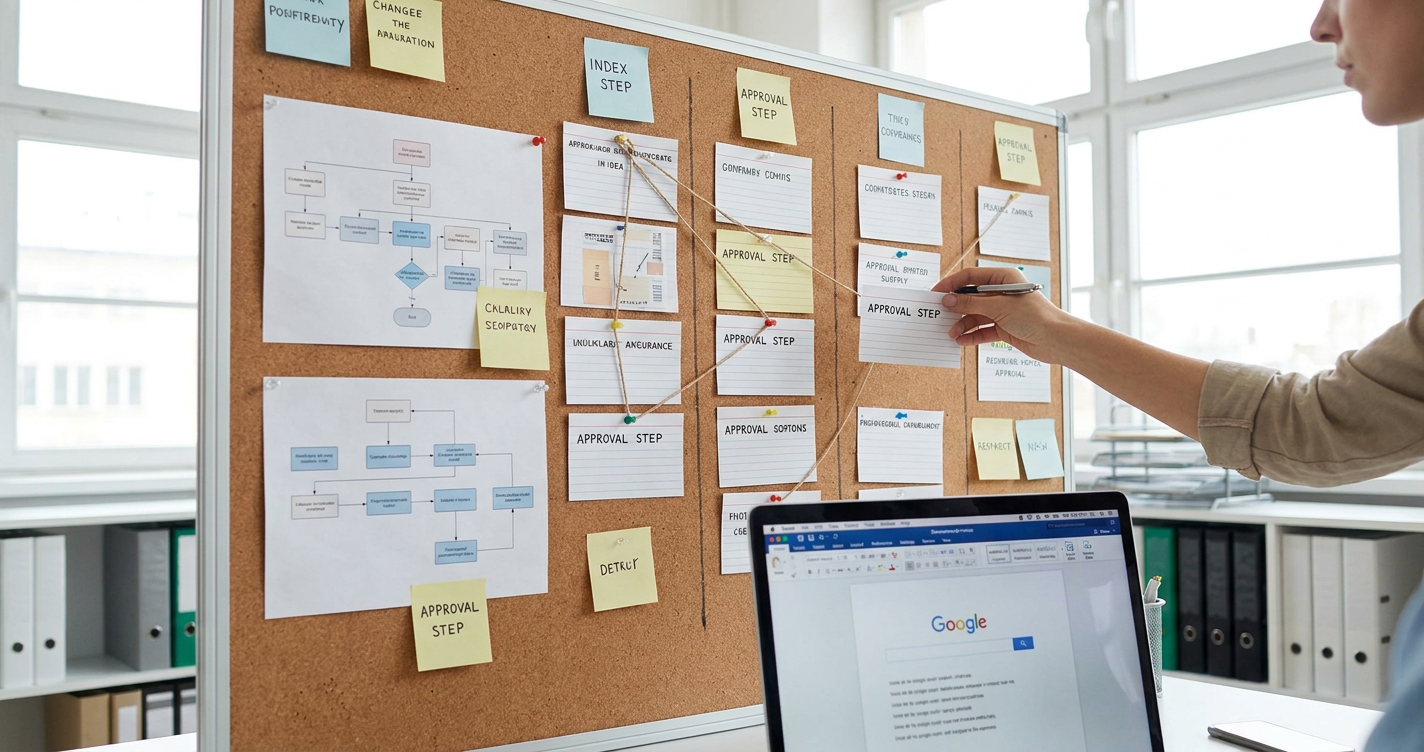
What is a systematic AEO workflow and why does it matter?
A systematic AEO workflow is a repeatable, documented process that ensures every piece of content you publish meets the structural, semantic, and technical requirements for citation by answer engines like ChatGPT, Claude, Perplexity, and Google AI Overviews. Unlike ad-hoc content creation, a systematic workflow embeds AEO compliance at every stage, from topic selection through publication, reducing the risk that content will be structurally invisible to AI systems. This matters because answer engines parse, extract, and cite content differently from traditional search engines. Without a defined workflow, teams produce content optimised for clicks but not for extraction, leaving visibility gains to chance rather than process.
The shift from traditional search to AI-mediated answers has introduced new technical requirements that most content teams were not built to handle. Answer engines favour content with explicit question-and-answer structures, entity-rich language, schema markup, and clear attribution. A systematic workflow ensures these elements are present in every article, not just the ones where a writer remembers to include them. It transforms AEO from a specialist skill into an operational standard.
The core stages of an AEO-compliant content workflow
An effective AEO workflow contains six distinct stages: audit and gap analysis, topic selection and keyword research, content brief creation, content generation, technical optimisation, and publication with tracking. Each stage has specific inputs, outputs, and quality gates that ensure the final article meets both traditional SEO requirements and the structural needs of answer engines.
The workflow begins with understanding what content already exists and where gaps remain. It ends with published content that includes schema markup, entity tagging, and tracking parameters that allow you to measure which articles generate citations. Between these endpoints, every decision point should ask not only whether the content will rank in traditional search results, but whether it will be extracted and cited by AI systems.
Stage one: Audit and gap analysis
Before creating new content, identify which existing pages are already citation-ready and which require structural updates. Run an AI visibility audit across your site to score pages for AEO compliance, examining whether articles include FAQPage schema, whether headings are phrased as questions, and whether answers appear immediately after those headings. This audit reveals patterns: certain content types may consistently lack entity-rich language, or older articles may be missing the structured data that answer engines rely on.
Gap analysis compares your existing content inventory against the topics and questions your target audience asks in conversational search. Unlike traditional keyword research, which focuses on search volume and difficulty, AEO gap analysis prioritises questions that answer engines are likely to extract and present as synthesised answers. Look for queries where competitors are being cited but your content is absent, and prioritise topics where you have domain authority but lack the structural formatting required for extraction.
Stage two: Topic selection and entity mapping
Select topics based on three criteria: relevance to your business, likelihood of answer engine extraction, and your ability to provide authoritative answers. Not every topic is equally suited to AEO. Answer engines favour informational queries with clear, factual answers over opinion pieces or promotional content. Prioritise how-to guides, definitional content, comparison articles, and process explanations.
Once you have selected a topic, map the entities that should appear in the content. Entities are the people, places, organisations, concepts, and objects that AI systems use to understand context and authority. If you are writing about answer engine optimisation, relevant entities include specific AI platforms (ChatGPT, Claude, Perplexity), technical concepts (schema markup, entity extraction, LLMO), and measurable outcomes (citation rates, attribution tracking). Entity-rich content writing ensures that AI systems can accurately categorise and extract your content.
Stage three: Content brief creation with AEO requirements
A content brief for AEO-compliant work must specify structural requirements, not just topic and word count. Include the primary question the article answers, a list of secondary questions to address in H2 or H3 headings, required entities to mention, schema markup types to implement, and internal linking targets. The brief should also specify whether the article will use FAQ format, how-to steps, or a traditional article structure.
Each heading in the brief should be phrased as a question or a clear topic statement that answer engines can extract. Avoid vague headings like "Key considerations" or "Important factors". Instead, use "What are the core stages of an AEO workflow?" or "How do you select topics for answer engine visibility?". This discipline at the brief stage prevents structural problems later. The brief is also the place to specify which content structures answer engines favour, ensuring writers understand the extraction requirements before drafting begins.
Stage four: Content generation with citation-first formatting
When generating content, lead every section with a direct, citation-friendly answer to the heading's implicit question. Answer engines extract the first one to three sentences after a heading more frequently than later paragraphs, so front-load the most important information. After the direct answer, expand with context, examples, and supporting detail. This inverted-pyramid structure works for both traditional readers and AI extraction systems.
Use short, declarative sentences for key facts and definitions. Avoid burying answers in subordinate clauses or multi-sentence constructions. If the heading asks "What is a systematic AEO workflow?", the first sentence should define it completely. Subsequent sentences can add nuance, but the extraction-ready answer must come first. This approach aligns with how AI systems identify and extract entities from content, prioritising clarity and directness over literary variation.
Vary sentence length to maintain readability, but keep critical statements concise. Answer engines are more likely to cite a 15-word sentence that directly answers a question than a 40-word sentence that meanders toward the same point. Where appropriate, use numbered lists for steps, bullet points for features or benefits, and tables for comparisons. These formats are easier for AI systems to parse and present in synthesised answers.
Stage five: Technical optimisation and schema implementation
After drafting, apply technical optimisation to ensure the content is machine-readable. Implement FAQPage schema markup if the article includes a question-and-answer section, HowTo schema if it provides step-by-step instructions, and Article schema for general content. Schema markup provides explicit signals to answer engines about content structure, making extraction more reliable.
Add entity annotations where appropriate, linking mentions of key concepts, organisations, or technical terms to authoritative sources or internal pages that define them. This creates a semantic web that AI systems can traverse to verify authority and context. Internal linking should connect to related topics that provide additional depth, using descriptive anchor text that tells both readers and AI systems what the linked page contains. For example, linking to automating content operations for AEO at scale provides context about workflow efficiency without requiring the current article to cover automation in depth.
Optimise meta descriptions and title tags for both traditional search and answer engine extraction. The meta description should summarise the article's primary answer in 110 to 160 characters, using the same direct, declarative style as the body content. Title tags should include the primary question or topic, phrased in a way that matches how users ask questions in conversational search.
Stage six: Publication, tracking, and iteration
Publish content with tracking parameters that allow you to measure answer engine attribution. Use UTM parameters or custom tracking codes to identify traffic that arrives after users interact with AI-synthesised answers. Unlike traditional search traffic, which arrives with clear referrer data from google.com or bing.com, answer engine traffic often appears as direct or unattributed in standard analytics. Implementing API-based content publishing can streamline deployment whilst ensuring tracking codes are consistently applied.
After publication, monitor which articles generate citations across ChatGPT, Claude, Perplexity, and Google AI Overviews. Track not only whether your content is cited, but what specific sentences or paragraphs are extracted. This feedback loop reveals which structural patterns work best for each platform, allowing you to refine briefs and generation processes over time. If certain headings consistently generate citations whilst others do not, adjust your brief templates to emphasise the successful patterns.
Iteration is essential. AEO is not a one-time optimisation but an ongoing process of testing, measurement, and refinement. Review citation performance monthly, identify underperforming content, and update articles to improve extraction likelihood. This might mean rephrasing headings as questions, adding FAQ schema to articles that lack it, or restructuring paragraphs to lead with direct answers.
Integrating AEO workflow with existing SEO processes
AEO workflow does not replace traditional SEO processes but extends them. The same keyword research, competitive analysis, and technical optimisation that support traditional search rankings also support answer engine visibility. The difference lies in the additional structural requirements: question-based headings, citation-friendly formatting, schema markup, and entity-rich language.
Integrate AEO requirements into existing content calendars, editorial guidelines, and quality checklists. If your current workflow includes a pre-publication SEO review, expand it to include AEO compliance checks: Does the article include at least one H2 phrased as a question? Does the first paragraph after each heading answer that question directly? Is FAQPage or HowTo schema implemented where appropriate? Are entities mentioned with sufficient context for AI systems to understand their relevance?
This integration ensures that AEO becomes a standard part of content operations rather than a separate, specialist activity. Writers, editors, and SEO professionals should all understand the basic principles of answer engine optimisation, even if technical implementation is handled by a smaller team. Understanding the difference between AEO and SEO helps teams recognise when additional structural work is required beyond traditional optimisation.
Common workflow failures and how to prevent them
The most common AEO workflow failure is inconsistency. Teams produce a handful of perfectly optimised articles and then revert to traditional formats for the majority of content. This happens when AEO requirements are treated as optional enhancements rather than mandatory quality gates. Prevent this by embedding AEO checks into content management systems, requiring schema markup and question-based headings before articles can be marked as complete.
Another frequent failure is optimising for a single answer engine whilst ignoring others. ChatGPT, Claude, Perplexity, and Google AI Overviews have overlapping but not identical extraction preferences. A workflow that optimises exclusively for Google AI Overviews may produce content that Perplexity rarely cites. Build flexibility into your workflow by testing content across multiple platforms and adjusting based on multi-platform citation performance.
Finally, many teams fail to measure answer engine attribution, making it impossible to demonstrate ROI or refine the workflow based on evidence. Without tracking, you cannot know which articles generate citations, which citations drive traffic, or which structural patterns correlate with better performance. Implement attribution tracking from the beginning, even if the data is imperfect, and refine measurement methods as you learn which signals matter most.
Tools and automation for workflow efficiency
Manual AEO workflows are time-consuming and error-prone. Automation reduces the risk of missing critical steps whilst increasing output volume. Content operations platforms can automate schema markup generation, entity tagging, internal linking, and even initial draft creation, ensuring that every article starts with AEO-compliant structure.
Automation is particularly valuable for schema implementation, which requires technical knowledge and careful attention to syntax. Manually writing JSON-LD markup for every article introduces errors and slows publication. Automated systems generate schema based on content structure, ensuring that FAQPage markup includes every question-and-answer pair and that HowTo schema accurately reflects numbered steps.
Similarly, entity extraction and linking can be partially automated, identifying mentions of key concepts and suggesting internal links to relevant pages. Whilst human review remains important, automation handles the repetitive work of scanning content for entity mentions and checking whether those entities have been linked appropriately. This allows writers and editors to focus on content quality rather than technical compliance.
Measuring workflow success and iteration
A successful AEO workflow produces measurable improvements in citation frequency, citation quality, and attributed traffic. Track the percentage of published articles that generate at least one citation within 30 days, the number of citations per article across different platforms, and the conversion rate of citations to actual site visits.
Citation quality matters as much as quantity. Being cited with a direct quote and attribution is more valuable than being mentioned in passing without a link. Track the distinction between cited and mentioned references, and prioritise structural changes that increase the former. If articles are frequently mentioned but rarely cited with attribution, the issue may be entity clarity or authoritative sourcing rather than overall content quality.
Iterate based on evidence. If how-to articles consistently generate more citations than definitional content, adjust your topic selection to favour procedural guides. If FAQ sections drive higher citation rates than traditional article structures, expand the use of FAQPage schema across more content types. The workflow should evolve as you gather data about what works for your specific domain, audience, and content types.
Frequently asked questions
How long does it take to implement a systematic AEO workflow?
Implementing a basic AEO workflow takes between two and four weeks for most content teams. This includes auditing existing content, creating AEO-compliant brief templates, training writers and editors on structural requirements, and setting up schema markup automation. Full integration with existing content management systems and attribution tracking may take an additional four to six weeks, depending on technical complexity and available development resources.
Can small teams maintain an AEO workflow without dedicated specialists?
Yes, small teams can maintain AEO workflows by using automation tools and embedding compliance checks into existing processes. The key is to make AEO requirements part of standard editorial guidelines rather than treating them as specialist tasks. Brief templates should specify structural requirements, content management systems should include schema markup automation, and pre-publication checklists should verify AEO compliance alongside traditional SEO factors. This allows generalist content teams to produce AEO-compliant work without requiring deep technical expertise for every article.
What is the most common reason AEO workflows fail after initial implementation?
The most common failure point is lack of measurement and feedback. Teams implement AEO structural requirements but do not track which articles generate citations or which citations drive traffic. Without this data, there is no evidence to justify continued investment in AEO-specific formatting, and workflows gradually revert to traditional SEO practices. Implementing citation tracking and attribution measurement from the beginning ensures that teams can demonstrate value and refine processes based on actual performance data.
How often should AEO workflow processes be reviewed and updated?
Review AEO workflow processes quarterly, examining citation performance data, platform changes, and team feedback. Answer engines update their extraction algorithms and preferences regularly, so structural patterns that worked well six months ago may become less effective. Quarterly reviews allow you to identify declining citation rates, test new formatting approaches, and incorporate lessons learned from high-performing content. Additionally, conduct an annual comprehensive audit of the entire workflow to identify systemic improvements and ensure alignment with broader content strategy.
Do AEO workflows require different approaches for different content types?
Yes, different content types benefit from tailored AEO approaches whilst maintaining core workflow principles. How-to guides should emphasise HowTo schema and numbered steps, definitional content should prioritise entity-rich language and clear answers immediately after headings, and comparison articles should use tables and structured data to present differences clearly. However, all content types should include question-based headings, citation-friendly opening paragraphs, and appropriate schema markup. The workflow should specify which structural elements are required for all content and which are content-type specific.